I thought sellers of multi-family homes in Queens had great expectations when I last posted on valuations back in mid June. Well, since then it seems dreams have gotten bigger and bolder. But it takes buyers with comparable visions to make a market and thus far, the latter, although by no means cautious, have not been willing to follow wannabe sellers all the way to the edge of the plank. That said, rational expectations can be found, if one looks hard enough.
Supply and Demand: Yes, But . . .
We all learned in Economics 101 that pricing is determined through the interaction of supply and demand. However, those who stayed awake beyond the first few lectures went on to learn that there’s more: You can’t just draw two lines on a graph (one representing supply and the other demand), point to the place where they cross and say “There it is, equilibrium, the market price. Now give me my ‘A’.”
To deserve an “A,” it was necessary to go further. We had to also understand that those lines weren’t fixed for all time. They were plotted as they were for particular reasons, and when the reasons changed, we had to re-draw the lines in new places. That meant that the intersection (the equilibrium, the market price) wold jump up and down all the time.
It’s easy to look at an MLS, identify what “comparable” properties sold for and identify that as the market price, the price at which buyers and sellers would agree after doing their negotiation theatrics. Actually though, it’s the right answer to the wrong question. It tells us where supply and demand have met, where prices have been (past tense). It does not tell us what prices will be when we buy and sell. To assess that, we need to develop reasonable expectations about where the drivers of supply and demand (the factors that make them what they are) will go.
Drivers of Supply
That’s an important topic but one that need not be explored at the moment, because sellers are demanding prices far in excess of what would be mandated by any rational analysis (considering what they paid, rates of return available in the market as a whole, etc.). It may not be that way for some and it may not be that way for many a year from now (i.e., those who have been buying recently have been paying through the nose and that will influence what they really need when it comes time for them to sell.)
Drivers of Demand
Here is where the action is: How does or should a buyer determine how much they can afford to pay?
With multifamily properties, typically purchased for investments, it all comes down to cash on cash return. How much must the investor pay (for debt service, for maintenance, for taxes, etc.) versus how much the investor will receive (rents). Much of the boom in real estate prices has occurred at a time when interest rates (which drive debt the service, typically the biggest cost item) were plummeting. Needless to say, if all else is equal, the passage of time which resulted in decreasing debt service costs meant buyer could afford to pay more and more. Sellers knew that and made darn sure they did.
Rental income for a long time has been stable to rising so that driver of buyer demand was healthy. And to top it all off, many overseas investors wanted to put money into the US at any cost.
What’s Likely Ahead
Falling interest rates are over, done, finished, gone, or as they say in traditional Brooklyn-ese, “Fuggedaboutit.”
How do I know this? Because benchmark rates in the US (short-term Treasuries), the rates that serve as jumping off points for all the others including those for mortgages, are near zero, and they can’t go negative. (NOTE: Ignore the smart-a** talking heads you see from time to time on TV who talk about negative interest rate. They are referring to overnight inter-institution lending rates that in some cases turned into fees. Genuine negative rates means you buy a house and your bank pays you 6% a year to take mortgage, or Visa pays you 10% annually on your credit card balances. That’s not going to happen.)
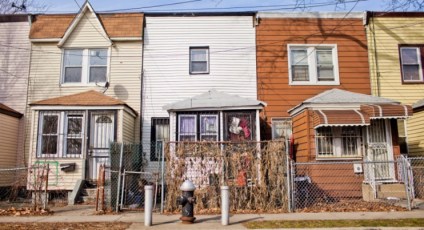
Rents, depend on what tenants can afford and on what they are willing to pay for a particula
r apartment. Even if job prospects remain good, the family that a year ago paid $1,800 a month for a possibly illegal semi basement in a circa 1915 dump might decide for another $200 a month, they’ll take a longer commute and live a lot better elsewhere.
Finally, China, the biggest source of foreign money put a lid on removal of currency from the country. That means many buyers who used to pay cash (and benefit from zero debt-service costs) are learning how to get mortgages (and take on this mega-expense) and banks have been helping them along often with five-year balloons (meaning, probably, higher interest rates and expenses down the road) and, I’ve been seeing, no-W2s no-nothing sub-prime — yeah, that again.
Plan B
There is an out. A buyer can accept very low, or even negative, cash on cash return if they have plausible expectations of gains in the future. This can come from property improvements, newfound popularity of a neighborhood, and/or increasing affluence on the part of future renters.
This is not a matter of pipe dreams. It’s played out many, many times and is still ongoing. It’s the G-word (gentrification).
The headlines focus on bold in-your-face gentrification, where once blighted areas become home to affluent people, high end restaurants, boutiques, luxury cars, etc. Think, for example, Williamsburg.
Gentrification can also be subtle. On the surface, the neighborhood looks pretty much the same but on closer examination, you notice the houses are better kept, the storefronts are occupied by merchants who are doing well, the streets are cleaner and the people stand taller and stride instead of just walk.
To find value in Queens today, look for the earliest or even preliminary stages of subtle gentrification.
The Numbers
Income-producing assets are typically valued on the basis of the cash flow the owner gets, over time and/or at the time of eventual sale. There are many ways to evaluate this and given the need to look into the un-knowable future, we often use spit-and-chewing gum approximations. With income-producing property, a particularly handy one is the price-to-rent ratio (P2R), the price for property divided by the expected annual rents.
How-to books and seminars suggest the P2R ratio should be in the 5-10 range. Realistically, unless you’re inclined to play the long-term turnaround game, don’t expect to buy at a P2R anywhere near that nowadays. There is no hard and fast rule about what P2R should be. Intrinsically correct ratios depend on many things relating to the prevailing level of interest rates, growth prospects and risk. Over the past generation, plunging interest rates alone have pushed all of these ratios well above what traditionalists say they should be.
Tables 1, 2 and 3 show average price-to-rent ratios in portions of Queens that tend to be favored by those who invest in multi (2-5) family residential properties. (I omit consideration of buildings with 6 or more units because the markets for those are often distorted by rent regulations.)
(Note: There is much estimation here. Prices of open, closed and expired listings are clear cut and readily available, but rents are estimated based on observed open for-rent listings for different combinations units in properties like these with different numbers of bedrooms and baths, and interpolation and approximation to adjust for the absence of data for certain combinations and adjustments for clear distortions involving unusual units.)
Table 1
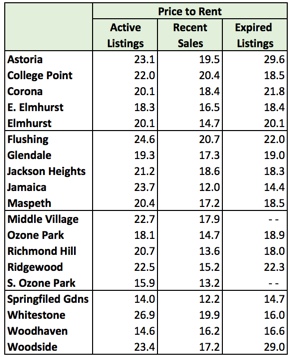
Table 2
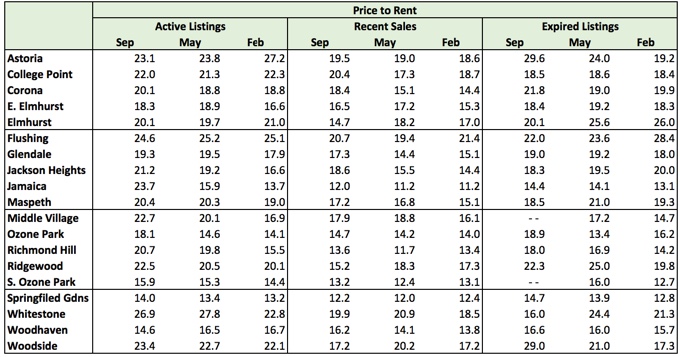
Table 3: Percent Changes 2/17 to 9/17

Observations
It’s not odd to see P2R ratios for active listings be higher than those of recent sales. Sellers are human, they don’t lead with their best and final offers and the Active Listing columns represent initial negotiation-starters. What’s noteworthy, however, is whether or to what extent ratios of recent sales trend the same way over time as do those of active listings.
We see a lot of variation in the trends from neighborhood to neighborhood. In Astoria, for example, we see (in Table 2) asking prices coming down sharply even as ratios on recent sales rose modestly. The reason is clear from Table 2. Relative to other sections of Queens, asking prices in Astoria in February were ridiculously high relative to rent levels, and buyers dug in their heels.
More often, however, we see asking prices rising relative to potential rents. Trends in the average ratios of listings that expire (those for which the buyer gave up and withdrew the listing or listed again, often with a new agent, at a lower price) show the extent of buyer intransigence.
Value Watch
I wrote in June that the southerly and easterly portions of this segment of Queens (Jamaica, South Ozone Park, Springfield Gardens, Richmond Hill) bear watching. That’s still the case and with Jamaica and South Ozone Park potentially holding the most interest.
This doesn’t necessarily mean sellers are being reasonable. But prevailing ratios have been relatively low in those areas and sellers are expecting those areas to rise. That’s especially so in Jamaica.
To be sure, one who invests here will need a strong tolerance for stress and good sources of backup liquidity. Large swaths of these areas remain blighted. A property owner can expect to become BFFs with local plumbers, electricians and carpenters as well as police officers and those who work in the clerk’s office of the Queens County Housing Court.
But if you ever looked at a place like Williamsburg, Greenpoint, Long Island City, Jackson Heights (where heated valuations have bene holding) or Bedford Stuyvesant and mused “I wish I had gotten in there at the right time,” well, the right time was when visions of tradespeople, court clerks, and police officers dominated your waking hours and most likely your dreams.
 I don’t suggest southeast Queens has quite as much upside as some of the other now-well-known gentrified areas. Commuting to Manhattan can be lengthy and arduous in many cases, Jamaica, with the Long Island Railroad hub, being the main exception. But not everybody is Manhattan centric. Nassau County is a major almost-urban center in its own right and Queens residents inclined to focus that way might find a rejuvenated southeast Queens, with its Nassau-like highway access and un-Nassau like taxes and distance form Manhattan a worthy alternative. Besides, downtown Jamaica is a major government hub in its own right and even for those whose hearts are in Manhattan, it’s not as if the ends of the A, E and F trains are much more burdensome than trips from upper Manhattan (honorary Bronx?) or the Bronx and those areas have become pretty hot.
The prospect of rising interest rates will challenge all real estate investors. There is no real protection against this unless one wants to stay into the financial markets (where one can buy ETFs that rise as interest rates rise and for those with a genuine taste for the exotic, sell housing futures). Absent moves like that, the best one can do is look for properties capable of being upwardly revalued on the basis of merit, rather than Federal Reserve generosity.

 NYC Real Estate Values