Sellers of multi-family homes in Queens have had great expectations thus far in 2017, following terrific times in recent years. It’s been a while since such properties could be described as bargains. But unlike tulip bulbs and like the stock market, there are limits to how high prices can legitimately go and in several neighborhoods, buyers have become more adept in saying just that, through actions if not words.
The Whys and Wherefores of Pricing
In economics, it’s all about supply and demand, and in real estate, conventional wisdom tells us to study the comps to learn the price levels at which supply and demand are meeting. That’s fine as far as it goes, which, actually, is not really all that far.
The real questions are what factors cause supply and demand to be what they are at various price points. Why might supply and demand for a particular property come together at $950,000 now, versus, say, $700,00 a couple of years ago.
Literally, the answer involves many things but to get a handle on the process, investors interested in owning rentable residences can focus on three broad factors; mortgage rates, rental income, and operating expenses. (The perfectionist will go further and look to the many causes of each, but investors who focus only on the broad-based big-three will already be way ahead and well positioned to buy and sell based not on what prices are now but on what they will be in the future.)
Today’s Focus: Rent
The theoretical work underlying the pricing of an income-producing asset has focused largely on financial (equity and fixed-income) markets, but the principals apply to any income-pricing asset, including real estate when used that way (as opposed to a personal residence). Because the computations rely on knowledge of the future, those of us who operate in the real world are forced to resort to spit-and-chewing gum approximations and one that is often used in real estate is the price-to-rent ratio (P2R), the price for property divided by the expected annual rents.
Hunting through books, on-line educational content, seminars and the like could lead one to assume the desirable P2R is in the 5-10 range. If you can find a buying opportunity in that range in and around New York City, and if the property is not an un-remediated toxic waste dump with a condemned building filled with militant non-paying tenants, grab it. Realistically, unless you’re inclined to play the long-term turnaround game, don’t expect to buy at a P2R anywhere near that nowadays.
There is no hard and fast rule about what P2R should be – just as there is no hard and fast rule about shat a price/earnings ratio or yield should be in the stock and fixed income markets respectively.
Intrinsically correct ratios depend on many things relating to the prevailing level of interest rates, growth prospects and risk. Over the past generation, plunging interest rates alone have pushed all of these ratios well above what traditionalists say they should be.
The Numbers
Table 1 lists average price-to-rent ratios in portions of Queens that tend to be favored by those who invest in multi (2-5) family residential properties. (I omit consideration of buildings with 6 or more units because the markets for those are often distorted by rent regulations.)
(Note: There is much estimation here. Prices of open, closed and expired listings are clear cut and readily available, but rents are estimate based on observed open for-rent listings for different combinations units in properties like these with different numbers of bedrooms and baths, and interpolation and approximation to adjust for the absence of data for certain combinations and adjustments for clear distortions involving unusual units.)
Table 1
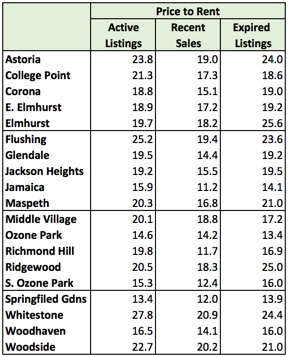
We see wide variations from neighborhood to neighborhood, which should not be surprising given how different one can be from others. And as a measure of ongoing flux in the marketplace, we see differences, some great, within each a particular neighborhood between the average ratio implied by asking prices (active for-sale listings), successful transactions (listings that resulted in sales that made it all the way to closing), and failed listings (those that expired without a sale).
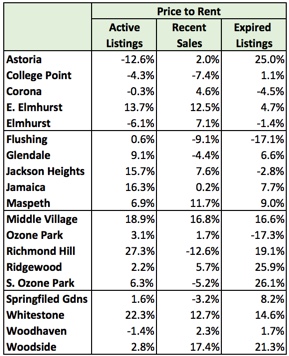
Table 2 shows differences between each ratio between the end of May and mid-February, the last time I complied and analyzed this data.
Table 2

Finally, Table 3 shows the February-to-March percent change in each ratio. Large positive numbers reflect seller willpower. Negative numbers indicate the extent to which buyers are taking control over the tempo of the market.
Table 3
Observations
By now, the imposition of controls by the Chinese government on removal of currency from that country and its implication for Chinese investors (many of who now are using mortgages as opposed to their former practice of buying for all cash) is well known. We see it having a dramatic impact on trends in Flushing, the heart of the Chinese community in Queens. In terms of active listings, Flushing remains one of the priciest areas in this portion of the borough. But buyer resistance is now intense. Back in the winter, some sellers were pricing at nearly 30 times annual rent, but they failed to find takers. To move properties there, P2Rs had to eventually dip below 20 on average.
Astoria, a near-Manhattan neighborhood that also inspired great ambitions on the parts of sellers has likewise had to hold average P2R a bit below 20 to close deals.
Corona and East Elmhurst have seen a lot of activity, as agents who work there know full well. But this has not been a rising tide capable of lifting all boats. There are many houses in good condition with reasonable access to Manhattan and Flushing as well as local shopping. But these are diverse areas and many properties fall short in one or more of those respects, enough so to keep average price-to-rant ratios of successful sales from climbing above the high teens.
Value Watch
The southerly portions of this segment of Queens (Jamaica, South Ozone Park, Springfield Gardens, Richmond Hill) bear watching.
Many investors and agents see these as marginal-or-less communities. Given today’s realities, it’s hard to argue with that. But with pricing in Manhattan and the chic sections of Brooklyn pushing upward and with market conditions likely to remain intense as the city’s top developers and brokers pour more resources into those areas, it’s becoming harder to ignore downtown Jamaica, with its major Long Island Railroad-focused transit hub and suitability for further commercial development, anchored by government offices and court houses already in place. Indeed, there are significant developers who have noticed and started to take action.
Interest Rates and Price Movement
Real estate investors have become spoiled of late. Notwithstanding the horrendous exceptions seen in and around 2008, it’s been incredibly easy for even the terrible deals to be bailed out by great capital gains, courtesy of Father Time and Uncle Sam. Interest rates in general have been on a consistent and powerful downtrend for about 35 years starting in 1982. All else being equal, lower interest rates pushes property prices upward. Considering the strength of the generational rate plunge we experienced, prices were often able to rise even when all else (rent growth, risk) leaned the wrong way.
All Else
Those days are over because benchmark interest rates have gone as close to zero as they can plausibly go. So going forward mortgage rates will remain more or less steady (subject to zigs and zags within a narrow range) and have an overall neutral impact on prices, or they’ll rise and exert downward pressure.
This means investors, developers, buyers, sellers, brokers will have to re-think the way they do business. Buyers and lenders will need to at least consider the prospect of rising rates in their decision processes. And all will have to pay more attention to prospects for increases or decreases in rent levels (the growth factor) and property quality (the risk factor).


Thank you for writing tthis
LikeLike